
As an Amazon Associate, Luxeluma earns from qualifying purchases. Our guides compare published specs. We don’t test devices in a lab, and nothing here is medical advice.
LED Light Therapy Wavelengths Explained: Red vs Blue vs Near-Infrared
Every LED beauty device sells you a wavelength. Red at 633 nanometers, blue somewhere in the 400s, near-infrared at 830. The numbers look scientific, which is exactly why they’re worth understanding before you spend $400 on a mask. Here’s what each wavelength band actually means, in plain terms, and how the best-known at-home devices use them.
What “wavelength” means on a spec sheet
Light is measured in nanometers (nm). The number tells you the color: shorter wavelengths are blue and violet, longer ones are red, and beyond red, invisible to your eyes, sits infrared. Device makers publish a wavelength because it identifies exactly which slice of light their LEDs emit.
Two things matter more than the marketing around the number:
- The wavelength itself. A device emitting red at 633nm and one emitting red at 660nm are both “red light devices,” but they’re technically different lights. Most at-home masks cluster around a few well-known values because those are the wavelengths with the longest history of study.
- Whether the number is even published. Serious devices list exact wavelengths. Vague claims like “7-color therapy” with no numbers are a yellow flag. You can’t evaluate what you can’t see.
Red light: 620–700nm, the surface worker
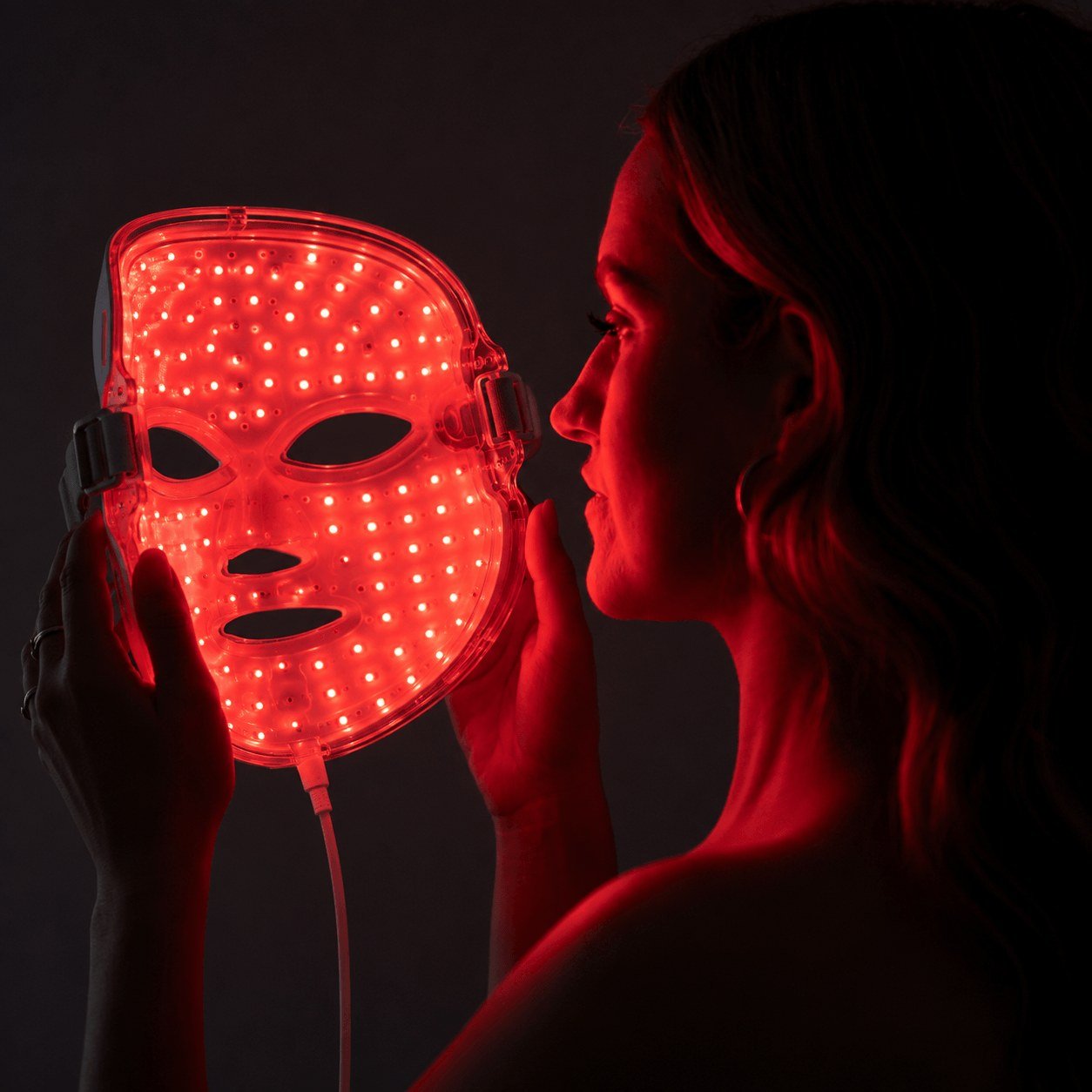
Red is the workhorse of at-home LED devices, and the most studied band for cosmetic use. It sits in the visible spectrum (you can see it glowing) and penetrates roughly 1–2 millimeters into skin, reaching the upper dermis.
In beauty marketing, red light is positioned for the appearance of fine lines and firmness. The commonly published values are 630nm, 633nm, 640nm, and 660nm. CurrentBody’s founder has called 633nm “the gold standard for red light,” and it’s no coincidence: the Omnilux Contour Face, the CurrentBody Skin LED mask, and the Dr. Dennis Gross SpectraLite all publish red wavelengths in the low-630s.
What to look for: an exact number (633nm beats “red light”), and ideally a power density figure in mW/cm², which tells you how much light actually reaches skin. CurrentBody publishes 30mW/cm² for its masks. Many brands publish nothing here, and that’s worth noticing.
Blue light: 450–495nm, the surface specialist
Blue sits at the short-wavelength end of visible light and barely penetrates past the skin’s surface. In device marketing, blue is aimed at blemish-prone skin. The idea is that surface-level light interacts with the upper layers where breakouts form.
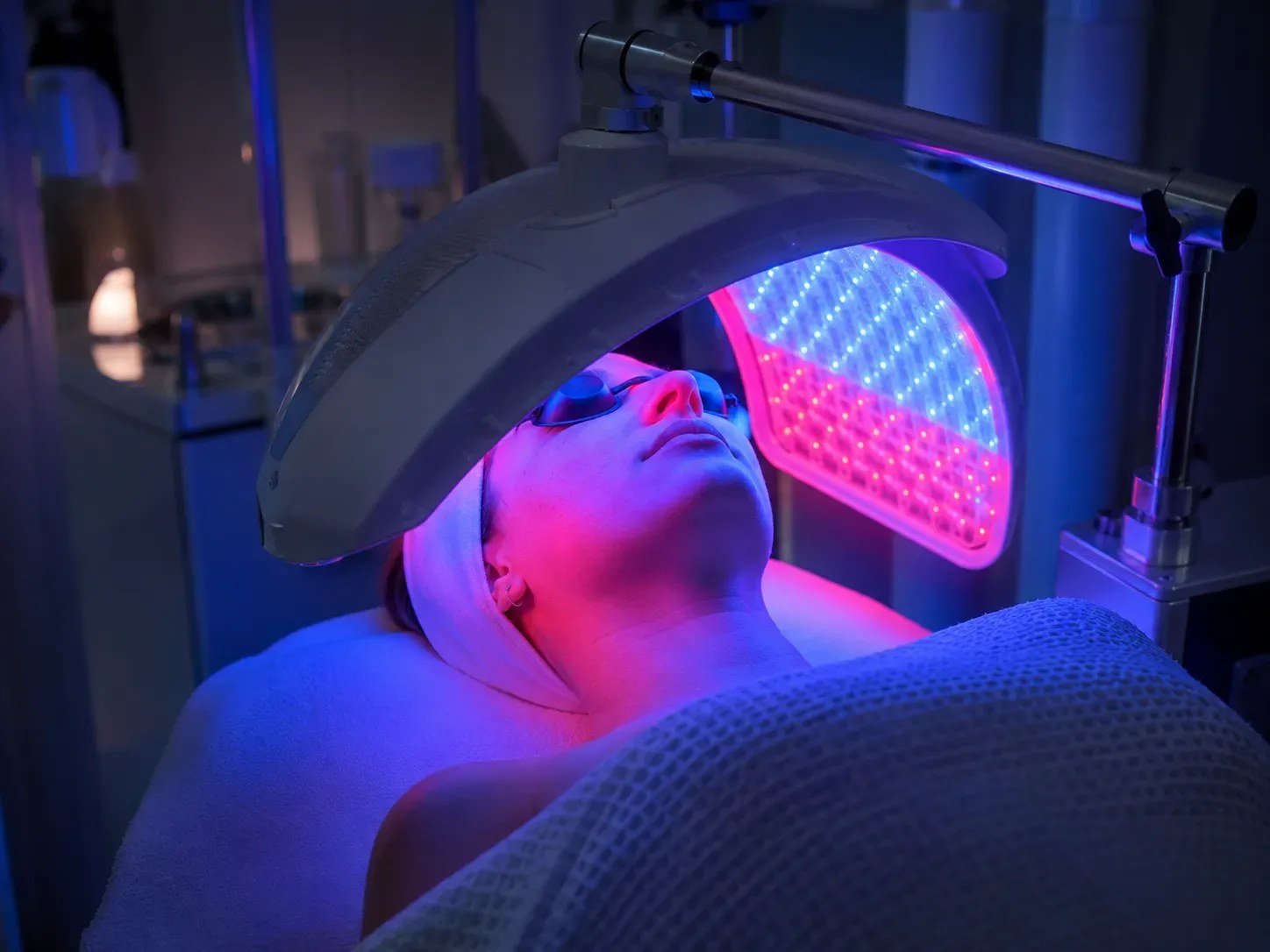
Among premium at-home devices, blue is relatively rare. The Dr. Dennis Gross DRx SpectraLite FaceWare Pro is the notable exception: it pairs 100 red LEDs with 62 blue LEDs and offers three modes (red only, blue only, or both together). Most LED masks skip blue entirely and focus on red plus near-infrared.
A practical note: blue light is the band most associated with eye sensitivity in bright sources. If you use a blue-light device, follow the manufacturer’s eye-protection guidance. The SpectraLite’s manual covers this, and it’s worth reading before your first session.
Near-infrared: 700–1000nm, the invisible deep layer
Near-infrared (NIR) is invisible. If your mask “doesn’t seem to be on” in a dark room, the NIR LEDs may still be running. Longer wavelengths penetrate deeper than visible light, which is why NIR is marketed for the look of firmness and a calmer-looking complexion.
The most published NIR value in beauty devices is 830nm: Omnilux, CurrentBody, and others all use it. CurrentBody’s Series 2 mask adds a third band, deep near-infrared at 1072nm, with 16 dedicated LEDs alongside its 110 red and 110 near-infrared bulbs.
Because you can’t see NIR, “is it working?” anxiety is common with dual-wavelength masks. It is a normal property of the light, not a defect. But it’s another reason to buy from brands that publish exact wavelengths rather than asking you to take it on faith.
How the well-known devices compare on wavelengths
| Device | Wavelengths published | LED count | Session |
|---|---|---|---|
| Dr. Dennis Gross DRx SpectraLite FaceWare Pro | Red + blue (3 modes) | 162 (100 red, 62 blue) | 3 min, auto shutoff |
| CurrentBody Skin LED Mask (Series 1) | 633nm red + 830nm near-infrared | 132 (66 + 66) | 10 min |
| CurrentBody Skin LED Mask (Series 2) | 633nm + 830nm + 1072nm deep NIR | 236 (110 + 110 + 16) | 10 min |
| Omnilux Contour Face | 633nm red + 830nm near-infrared | 132 (66 dual bulbs) | 10 min |
All figures are as published by the brands. The pattern is clear: 633nm red and 830nm near-infrared are the consensus wavelengths. Blue is the outlier. Only the SpectraLite offers it, which makes that device the pick if blemish-prone skin is your primary concern rather than the look of fine lines.
What wavelength can’t tell you
Wavelength is necessary but not sufficient. Two devices can share the exact same 633nm red and perform differently because of:
- Power density (mW/cm²). How much light energy reaches your skin per second. Higher isn’t automatically better, but unpublished is uninformative.
- Treatment time. A 3-minute session and a 10-minute session deliver different total doses even at identical power.
- Fit and distance. Light follows the inverse-square law: a mask that sits flush against skin delivers more than a panel across the room. Flexible silicone masks that contour to the face exist for this reason.
- Consistency. Every brand’s usage guidance converges on the same point: 3–5 sessions per week for 4–8 weeks before judging anything. A device you won’t use is the wrong device at any wavelength.
Choosing by concern: a practical shortcut
- Appearance of fine lines and firmness is the priority: red + near-infrared is the standard pairing. Compare the LED mask buying guide for how the Omnilux, CurrentBody, and SpectraLite differ on fit, session length, and price.
- Blemish-prone skin is the priority: look specifically for a blue-light mode. The SpectraLite FaceWare Pro is the only premium mask in our comparison that offers one.
- You want the shortest sessions: the SpectraLite’s 3-minute auto-shutoff cycle is the briefest here; the others run 10 minutes.
- You want the most published data: CurrentBody’s Series 2 publishes three wavelengths, LED counts per band, and 30mW/cm² power density, the most transparent spec sheet of the group.
For the other half of the at-home device world, the ones that use electricity instead of light, see our microcurrent devices explainer.
Frequently asked questions
Can you combine wavelengths in one session?
Yes. Several devices do it by design. The SpectraLite has a red+blue combined mode, and most red+NIR masks run both bands simultaneously. There’s no at-home reason to buy two single-wavelength devices.
Does more LEDs mean better results?
Not directly. LED count affects coverage and evenness, but dose depends on power density and session time. A 236-LED mask and a 132-LED mask can deliver similar doses if their power and timing differ.
Is near-infrared safe if I can’t see it?
The invisibility is a property of the wavelength, not a warning sign. Still, follow each manufacturer’s eye guidance. Some recommend the included goggles, while others design the mask so light doesn’t reach the eyes.
Why do all the brands converge on 633nm and 830nm?
Those wavelengths have the longest publication history in light research, so they’re the safest choices for a brand to build around. Convergence here is a good sign. It means the industry agrees on the fundamentals.
How we research
Luxeluma compares manufacturer-published specifications: wavelengths, LED counts, session times, and clearance status as stated by the brands. We don’t run lab tests, and cosmetic devices aren’t medicine: nothing on this page diagnoses, treats, or prevents any condition. When a brand publishes a number, we report it; when it doesn’t, we say so.